9.6.8. Summary of error types and strategies to overcome them
A jegyzet hozzáadásához kérjük, lépj be!
Hivatkozások
Válaszd ki a számodra megfelelő formátumot:
| Harvard: | Jenei Gabriella (2024): Referential Cohesion in Academic Writing. : Akadémiai Kiadó.
https://doi.org/10.1556/9789636640491Letöltve: https://uat.mersz.hu/hivatkozas/m1211rciaw_148_p1/#m1211rciaw_148_p1 (2026. 10. 13.)
| |
| Chicago: | Jenei Gabriella. 2024. Referential Cohesion in Academic Writing. : Akadémiai Kiadó.
https://doi.org/10.1556/9789636640491(Letöltve: 2026. 10. 13.https://uat.mersz.hu/hivatkozas/m1211rciaw_148_p1/#m1211rciaw_148_p1) | |
| APA: | Jenei G. (2024). Referential Cohesion in Academic Writing. Akadémiai Kiadó.
https://doi.org/10.1556/9789636640491. (Letöltve: 2026. 10. 13.https://uat.mersz.hu/hivatkozas/m1211rciaw_148_p1/#m1211rciaw_148_p1) |
By Stage 4 of this study (in Chapter 8) it has already become evident that errors in cohesive reference may affect textual cohesion, whether the error occurs on the level of the sentence, or it affects a larger segment of text. In Chapter 8, the three criteria for identifying a reference error were specified, which basically all stated that for one reason or another, it is not possible to identify the presupposed item for a referring item.
A jegyzet hozzáadásához kérjük, lépj be!
Hivatkozások
Válaszd ki a számodra megfelelő formátumot:
| Harvard: | Jenei Gabriella (2024): Referential Cohesion in Academic Writing. : Akadémiai Kiadó.
https://doi.org/10.1556/9789636640491Letöltve: https://uat.mersz.hu/hivatkozas/m1211rciaw_148_p2/#m1211rciaw_148_p2 (2026. 10. 13.)
| |
| Chicago: | Jenei Gabriella. 2024. Referential Cohesion in Academic Writing. : Akadémiai Kiadó.
https://doi.org/10.1556/9789636640491(Letöltve: 2026. 10. 13.https://uat.mersz.hu/hivatkozas/m1211rciaw_148_p2/#m1211rciaw_148_p2) | |
| APA: | Jenei G. (2024). Referential Cohesion in Academic Writing. Akadémiai Kiadó.
https://doi.org/10.1556/9789636640491. (Letöltve: 2026. 10. 13.https://uat.mersz.hu/hivatkozas/m1211rciaw_148_p2/#m1211rciaw_148_p2) |
Here, error types encountered in the corpus of 20 MA theses are reviewed based on the categories of errors that emerged in the fourth stage of this research, which means that the four main types of errors identified so far are reference items with:
A jegyzet hozzáadásához kérjük, lépj be!
Hivatkozások
Válaszd ki a számodra megfelelő formátumot:
| Harvard: | Jenei Gabriella (2024): Referential Cohesion in Academic Writing. : Akadémiai Kiadó.
https://doi.org/10.1556/9789636640491Letöltve: https://uat.mersz.hu/hivatkozas/m1211rciaw_148_p3/#m1211rciaw_148_p3 (2026. 10. 13.)
| |
| Chicago: | Jenei Gabriella. 2024. Referential Cohesion in Academic Writing. : Akadémiai Kiadó.
https://doi.org/10.1556/9789636640491(Letöltve: 2026. 10. 13.https://uat.mersz.hu/hivatkozas/m1211rciaw_148_p3/#m1211rciaw_148_p3) | |
| APA: | Jenei G. (2024). Referential Cohesion in Academic Writing. Akadémiai Kiadó.
https://doi.org/10.1556/9789636640491. (Letöltve: 2026. 10. 13.https://uat.mersz.hu/hivatkozas/m1211rciaw_148_p3/#m1211rciaw_148_p3) |
- no referent in the textual context,
- vague reference,
- problematic tracking of reference,
- non-existent forms.
A jegyzet hozzáadásához kérjük, lépj be!
Hivatkozások
Válaszd ki a számodra megfelelő formátumot:
| Harvard: | Jenei Gabriella (2024): Referential Cohesion in Academic Writing. : Akadémiai Kiadó.
https://doi.org/10.1556/9789636640491Letöltve: https://uat.mersz.hu/hivatkozas/m1211rciaw_148_p5/#m1211rciaw_148_p5 (2026. 10. 13.)
| |
| Chicago: | Jenei Gabriella. 2024. Referential Cohesion in Academic Writing. : Akadémiai Kiadó.
https://doi.org/10.1556/9789636640491(Letöltve: 2026. 10. 13.https://uat.mersz.hu/hivatkozas/m1211rciaw_148_p5/#m1211rciaw_148_p5) | |
| APA: | Jenei G. (2024). Referential Cohesion in Academic Writing. Akadémiai Kiadó.
https://doi.org/10.1556/9789636640491. (Letöltve: 2026. 10. 13.https://uat.mersz.hu/hivatkozas/m1211rciaw_148_p5/#m1211rciaw_148_p5) |
Each of these will be dealt with in a separate subsection. Based on the qualitative analysis, examples are presented from the corpora alongside suggested strategies to help avoid or overcome these problems drawing on results of the analysis of RAs. (Several details and examples of error types were already discussed in Chapter 8 and will therefore not be repeated here.)
A jegyzet hozzáadásához kérjük, lépj be!
Hivatkozások
Válaszd ki a számodra megfelelő formátumot:
| Harvard: | Jenei Gabriella (2024): Referential Cohesion in Academic Writing. : Akadémiai Kiadó.
https://doi.org/10.1556/9789636640491Letöltve: https://uat.mersz.hu/hivatkozas/m1211rciaw_fig_42/#m1211rciaw_fig_42 (2026. 10. 13.)
| |
| Chicago: | Jenei Gabriella. 2024. Referential Cohesion in Academic Writing. : Akadémiai Kiadó.
https://doi.org/10.1556/9789636640491(Letöltve: 2026. 10. 13.https://uat.mersz.hu/hivatkozas/m1211rciaw_fig_42/#m1211rciaw_fig_42) | |
| APA: | Jenei G. (2024). Referential Cohesion in Academic Writing. Akadémiai Kiadó.
https://doi.org/10.1556/9789636640491. (Letöltve: 2026. 10. 13.https://uat.mersz.hu/hivatkozas/m1211rciaw_fig_42/#m1211rciaw_fig_42) |
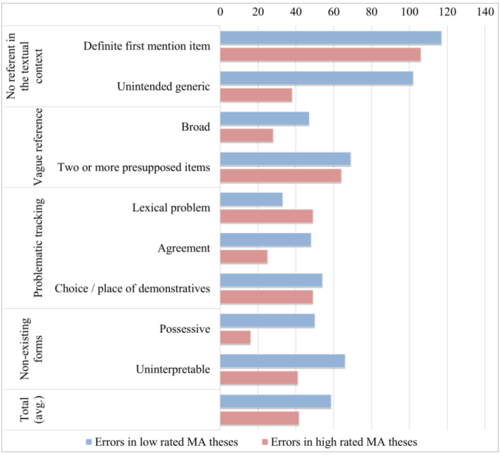
Figure 26 Errors in MA theses
A jegyzet hozzáadásához kérjük, lépj be!
Hivatkozások
Válaszd ki a számodra megfelelő formátumot:
| Harvard: | Jenei Gabriella (2024): Referential Cohesion in Academic Writing. : Akadémiai Kiadó.
https://doi.org/10.1556/9789636640491Letöltve: https://uat.mersz.hu/hivatkozas/m1211rciaw_148_p8/#m1211rciaw_148_p8 (2026. 10. 13.)
| |
| Chicago: | Jenei Gabriella. 2024. Referential Cohesion in Academic Writing. : Akadémiai Kiadó.
https://doi.org/10.1556/9789636640491(Letöltve: 2026. 10. 13.https://uat.mersz.hu/hivatkozas/m1211rciaw_148_p8/#m1211rciaw_148_p8) | |
| APA: | Jenei G. (2024). Referential Cohesion in Academic Writing. Akadémiai Kiadó.
https://doi.org/10.1556/9789636640491. (Letöltve: 2026. 10. 13.https://uat.mersz.hu/hivatkozas/m1211rciaw_148_p8/#m1211rciaw_148_p8) |
Figure 26 summarizes the number of errors found in total in the MA thesis corpus. As expected, low-rated theses contained a greater number of errors, except for the lexical category. The greatest difference between the high- and low-rated corpora was found in the following three categories: possessives, agreement, and unintended generic reference. Both corpora were similar in that the most worrying category of errors is the one where there is a missing presupposed item; that is, the referred entity is not introduced with a full form or an indefinite item in the text, but there is a definite noun phrase referring to it. Let us start the discussion of each category of errors with this.