6.6.4. New and extended chains
A jegyzet hozzáadásához kérjük, lépj be!
Hivatkozások
Válaszd ki a számodra megfelelő formátumot:
| Harvard: | Jenei Gabriella (2024): Referential Cohesion in Academic Writing. : Akadémiai Kiadó.
https://doi.org/10.1556/9789636640491Letöltve: https://uat.mersz.hu/hivatkozas/m1211rciaw_88_p1/#m1211rciaw_88_p1 (2026. 10. 11.)
| |
| Chicago: | Jenei Gabriella. 2024. Referential Cohesion in Academic Writing. : Akadémiai Kiadó.
https://doi.org/10.1556/9789636640491(Letöltve: 2026. 10. 11.https://uat.mersz.hu/hivatkozas/m1211rciaw_88_p1/#m1211rciaw_88_p1) | |
| APA: | Jenei G. (2024). Referential Cohesion in Academic Writing. Akadémiai Kiadó.
https://doi.org/10.1556/9789636640491. (Letöltve: 2026. 10. 11.https://uat.mersz.hu/hivatkozas/m1211rciaw_88_p1/#m1211rciaw_88_p1) |
When dividing the RA into subsections, two main types of referential chains can be identified: extended (which have their referent in some previous Section) and new. The ratio of new and extended chains in each Section shows the ratio of new referents introduced. Figure 11 shows the outcome of this analysis. In Figure 11, the rightmost two columns represent the ratio of the total number of new and extended chains in the RAs, as compared to Biber et al.’s (1998) results for given versus new referring expressions in academic prose. The similarity of the two columns hopefully provides some evidence to the validity of this part of the present study.
A jegyzet hozzáadásához kérjük, lépj be!
Hivatkozások
Válaszd ki a számodra megfelelő formátumot:
| Harvard: | Jenei Gabriella (2024): Referential Cohesion in Academic Writing. : Akadémiai Kiadó.
https://doi.org/10.1556/9789636640491Letöltve: https://uat.mersz.hu/hivatkozas/m1211rciaw_fig_14/#m1211rciaw_fig_14 (2026. 10. 11.)
| |
| Chicago: | Jenei Gabriella. 2024. Referential Cohesion in Academic Writing. : Akadémiai Kiadó.
https://doi.org/10.1556/9789636640491(Letöltve: 2026. 10. 11.https://uat.mersz.hu/hivatkozas/m1211rciaw_fig_14/#m1211rciaw_fig_14) | |
| APA: | Jenei G. (2024). Referential Cohesion in Academic Writing. Akadémiai Kiadó.
https://doi.org/10.1556/9789636640491. (Letöltve: 2026. 10. 11.https://uat.mersz.hu/hivatkozas/m1211rciaw_fig_14/#m1211rciaw_fig_14) |
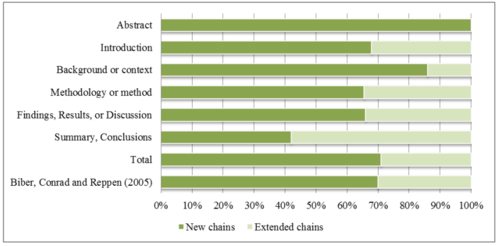
Figure 11 The ratio of new and extended chains per section in 10 RAs
A jegyzet hozzáadásához kérjük, lépj be!
Hivatkozások
Válaszd ki a számodra megfelelő formátumot:
| Harvard: | Jenei Gabriella (2024): Referential Cohesion in Academic Writing. : Akadémiai Kiadó.
https://doi.org/10.1556/9789636640491Letöltve: https://uat.mersz.hu/hivatkozas/m1211rciaw_88_p4/#m1211rciaw_88_p4 (2026. 10. 11.)
| |
| Chicago: | Jenei Gabriella. 2024. Referential Cohesion in Academic Writing. : Akadémiai Kiadó.
https://doi.org/10.1556/9789636640491(Letöltve: 2026. 10. 11.https://uat.mersz.hu/hivatkozas/m1211rciaw_88_p4/#m1211rciaw_88_p4) | |
| APA: | Jenei G. (2024). Referential Cohesion in Academic Writing. Akadémiai Kiadó.
https://doi.org/10.1556/9789636640491. (Letöltve: 2026. 10. 11.https://uat.mersz.hu/hivatkozas/m1211rciaw_88_p4/#m1211rciaw_88_p4) |
As regards the sections in the papers, the Abstract cannot contain any extended chains, but it is closely related to the Introduction, as shown by the relatively high percentage of extended chains in the Introduction. The Background again contains more new chains, thus probably more new information, which is then referred to by various elements in the Method and Findings sections. This high ratio of extended chains in the Method section of RAs supports the observation by Swales (1990, 169) that in “soft” sciences, the Method is very explicit, and contains a detailed description supported by a high number of anaphoric references and lexical repetition. As can be expected, the Summary and Conclusions section carry low new information, as shown by the lowest percentage of new chains, but has the highest portion of extended chains as compared to the other sections.