(A) SENTENCE-INTERNAL:
A jegyzet hozzáadásához kérjük, lépj be!
Hivatkozások
Válaszd ki a számodra megfelelő formátumot:
| Harvard: | Jenei Gabriella (2024): Referential Cohesion in Academic Writing. : Akadémiai Kiadó.
https://doi.org/10.1556/9789636640491Letöltve: https://uat.mersz.hu/hivatkozas/m1211rciaw_97_p1/#m1211rciaw_97_p1 (2026. 10. 11.)
| |
| Chicago: | Jenei Gabriella. 2024. Referential Cohesion in Academic Writing. : Akadémiai Kiadó.
https://doi.org/10.1556/9789636640491(Letöltve: 2026. 10. 11.https://uat.mersz.hu/hivatkozas/m1211rciaw_97_p1/#m1211rciaw_97_p1) | |
| APA: | Jenei G. (2024). Referential Cohesion in Academic Writing. Akadémiai Kiadó.
https://doi.org/10.1556/9789636640491. (Letöltve: 2026. 10. 11.https://uat.mersz.hu/hivatkozas/m1211rciaw_97_p1/#m1211rciaw_97_p1) |
Table 19 lists in the first category (A1–A3) all those items that appear in the Referential Cohesion Analysis (i.e., personal, demonstrative, comparative reference), but whose presupposed items are in the same sentence.
A jegyzet hozzáadásához kérjük, lépj be!
Hivatkozások
Válaszd ki a számodra megfelelő formátumot:
| Harvard: | Jenei Gabriella (2024): Referential Cohesion in Academic Writing. : Akadémiai Kiadó.
https://doi.org/10.1556/9789636640491Letöltve: https://uat.mersz.hu/hivatkozas/m1211rciaw_fig_17/#m1211rciaw_fig_17 (2026. 10. 11.)
| |
| Chicago: | Jenei Gabriella. 2024. Referential Cohesion in Academic Writing. : Akadémiai Kiadó.
https://doi.org/10.1556/9789636640491(Letöltve: 2026. 10. 11.https://uat.mersz.hu/hivatkozas/m1211rciaw_fig_17/#m1211rciaw_fig_17) | |
| APA: | Jenei G. (2024). Referential Cohesion in Academic Writing. Akadémiai Kiadó.
https://doi.org/10.1556/9789636640491. (Letöltve: 2026. 10. 11.https://uat.mersz.hu/hivatkozas/m1211rciaw_fig_17/#m1211rciaw_fig_17) |
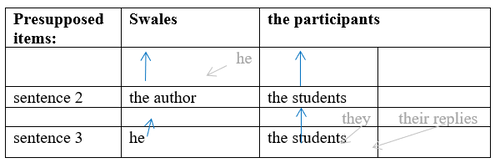
Figure 13 Sentence-internal reference
A jegyzet hozzáadásához kérjük, lépj be!
Hivatkozások
Válaszd ki a számodra megfelelő formátumot:
| Harvard: | Jenei Gabriella (2024): Referential Cohesion in Academic Writing. : Akadémiai Kiadó.
https://doi.org/10.1556/9789636640491Letöltve: https://uat.mersz.hu/hivatkozas/m1211rciaw_97_p4/#m1211rciaw_97_p4 (2026. 10. 11.)
| |
| Chicago: | Jenei Gabriella. 2024. Referential Cohesion in Academic Writing. : Akadémiai Kiadó.
https://doi.org/10.1556/9789636640491(Letöltve: 2026. 10. 11.https://uat.mersz.hu/hivatkozas/m1211rciaw_97_p4/#m1211rciaw_97_p4) | |
| APA: | Jenei G. (2024). Referential Cohesion in Academic Writing. Akadémiai Kiadó.
https://doi.org/10.1556/9789636640491. (Letöltve: 2026. 10. 11.https://uat.mersz.hu/hivatkozas/m1211rciaw_97_p4/#m1211rciaw_97_p4) |
In Figure 13, rows represent sentences (from RA12); blue arrows represent cohesive ties between referring expressions and presupposed items. Expressions with gray arrows show items that are less specific according to Biber et al.’s (1991, 234) degrees of reference (see Table 3) and point to a more specific item in the same sentence. In deciding whether or not an item has a presupposed item in the same sentence, it can generally be assumed that any item that contains a lexically related NP is higher up the scale than the pronouns in the same sentence.
A jegyzet hozzáadásához kérjük, lépj be!
Hivatkozások
Válaszd ki a számodra megfelelő formátumot:
| Harvard: | Jenei Gabriella (2024): Referential Cohesion in Academic Writing. : Akadémiai Kiadó.
https://doi.org/10.1556/9789636640491Letöltve: https://uat.mersz.hu/hivatkozas/m1211rciaw_fig_18/#m1211rciaw_fig_18 (2026. 10. 11.)
| |
| Chicago: | Jenei Gabriella. 2024. Referential Cohesion in Academic Writing. : Akadémiai Kiadó.
https://doi.org/10.1556/9789636640491(Letöltve: 2026. 10. 11.https://uat.mersz.hu/hivatkozas/m1211rciaw_fig_18/#m1211rciaw_fig_18) | |
| APA: | Jenei G. (2024). Referential Cohesion in Academic Writing. Akadémiai Kiadó.
https://doi.org/10.1556/9789636640491. (Letöltve: 2026. 10. 11.https://uat.mersz.hu/hivatkozas/m1211rciaw_fig_18/#m1211rciaw_fig_18) |
A jegyzet hozzáadásához kérjük, lépj be!
Hivatkozások
Válaszd ki a számodra megfelelő formátumot:
| Harvard: | Jenei Gabriella (2024): Referential Cohesion in Academic Writing. : Akadémiai Kiadó.
https://doi.org/10.1556/9789636640491Letöltve: https://uat.mersz.hu/hivatkozas/m1211rciaw_97_p6/#m1211rciaw_97_p6 (2026. 10. 11.)
| |
| Chicago: | Jenei Gabriella. 2024. Referential Cohesion in Academic Writing. : Akadémiai Kiadó.
https://doi.org/10.1556/9789636640491(Letöltve: 2026. 10. 11.https://uat.mersz.hu/hivatkozas/m1211rciaw_97_p6/#m1211rciaw_97_p6) | |
| APA: | Jenei G. (2024). Referential Cohesion in Academic Writing. Akadémiai Kiadó.
https://doi.org/10.1556/9789636640491. (Letöltve: 2026. 10. 11.https://uat.mersz.hu/hivatkozas/m1211rciaw_97_p6/#m1211rciaw_97_p6) |
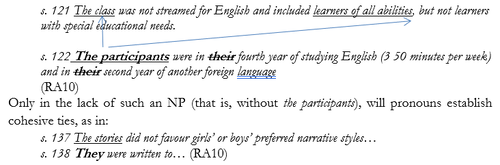
The remaining categories (A4–6) are also similar in that the specification for an item is in the same sentence. Reflexive pronouns “mark identity with a preceding noun phrase” (Biber et al., 1991, 70), and usually refer to an entity in the same sentence; that is, they are only grammatically cohesive: e.g., s. 56 […] only a portion of the graphic material itself (RA9). Specification of the presupposed item sometimes occurs in brackets in the same sentence, e.g., s. 160 […] when they [students] go onto the following unit (RA15) or immediately after the definite NP, e.g., s. 301 It also revealed a dual meaning of the term human (RA15).